Search This Blog

Monday, April 7, 2014

Training that helps churches reproduce in the country that has the fastest growing church in the world!


What is God doing in the Himalayas? Some pretty exciting things! I have been going yearly to Nepal to develop, empower and release church planters and all I can say is that I have found the context pregnant with missional passion. Then one of the leaders there shared with me that a church growth study coming from Gordon Conwell seminary's Center for Global Studies found that Nepal has the fastest growing church at this time, followed closely by China. That report is quoted here: http://discipleallnations.wordpress.com/2013/08/25/the-top-20-countries-where-christianity-is-growing-the-fastest/

I give God all the glory. The best way I know how, is to share how I saw God at work during the last two weeks of March 2014.


I flew from Berlin to Kathmandu, Nepal on March 16. Craig Ott and I enjoyed working with the 30 leaders who participated in level 3- Training of Trainers. These were those who had participated in level one and two training and came back to share what God was doing and prepare to become trainers of other church planters.

 As the Nepali custom goes, participants sat on the floor which made it easy to work in groups.

 The training was rich in excitement, discussion and practical application. 

 
Our training team was composed of Dr. Craig Ott and I but several others shared from their church planting experience.


The Church Planting Training Network (CPTN) of Kathmandu prepared well and organized several case studies illustrating the impact of Level one and two training.
 Tilak Thapa planted new churches in Lalitpur (near Kathmandu) and Kapri (in the mountains) and three other churches in the Lamju district near Tibet.
 Indra Shestra, with the leaders he trained and coaches, started 3 new churches near the Tibet border and strengthened 15 others.

 Krishna Dangol has been the most prolific church planter. He works with others in seven regions to start 16 churches and 13 more are projected. 
One of the most helpful tools has been the "four field" church planting process. They learn what to do at each stage: the empty field, the seeded field, the fruitful field and the harvest field. The the process starts over because mature churches look for new empty fields.  


  • The CPTN produced a manual combining Level 1 and 3 and another manual for the Training of Trainers. 

    One day there was a political protest by the Marxists and all public transportation including taxis came to a halt. Cars were warned not to attempt to break the strike. Some that did were turned over and burned. At first the second day of training was canceled. But the trainees got through on their motorcycles and came to ge us at our hotel. The Lord made a way!


     My protective angel who got me through the city unharmed.

     Blake, one of Craig Ott's students enjoyed the adventure.


     Learners worked together to make regional plans to train more church planters.
    Then they chose a point person to share their vision and plans with the group. In the end they received certificates. The trainees decided to work together to reproduce church planter training in outlying regions through 14 second generation training events this year. That’s multiplication!


The Kathmandu CPTN will help by producing manuals at or below cost and by sending members to help with the Gen. 2 trainings. Hershey Evangelical Free Church has provided a fund to subsidize the cost of producing manuals in the poorer areas. 


On March 24, I flew across Nepal and met up with my team mate Mark Wold in Bagdogra, N. India. During our four-hour drive north to the Bhutan border, Sam Sharma, our host and key leader of the movement, hit a pedestrian. An angry crowd surrounded our car. We took him to see a doctor, fearful that he might have internal injuries and die on the way. We prayed desperately. God answered. He had surface wounds but no serious injury. We asked God to use Sam’s care and witness to save this man as we went to bed for our first night in Jaigaon. 
The three following days, Mark Wold and I taught Level 2: Biblical Foundations for Building and Reproducing Healthy, Transformational Churches – to help church planters plant churches that are increasingly healthy & impactful and will reproduce. 


The 39 men and women we trained were extremely eager to learn. They will now be passing on the training to the other pastors and leaders in their home regions. It is such a key crossroad, strategic area for training leaders – so close to the borders of Nepal, Sikkim, Bhutan, Assam, Bangladesh, China, and Myanmar. And they are drawing pastors, leaders and students from each of those areas, except China to date.
(Training center and Sharma home)

The last day we debriefed and strategized with the organizing team. They honored us by giving us gifts and invited us to return next year for the Training of Trainers. We prayed with them for wisdom to implement the strategic plans they have developed - teaching others and forming their teams to reproduce healthy churches back in their home countries, particularly in Bhutan, a creative access country.
 The cake says 50 years of faithfulness. I told Sam I have been a Christian for 50 years and he surprised me with this. My testimony is 50 years of His faithfulness not mine. I don't deserve any recognition!
 Young and old shared what God was teaching them.
 There were solemn moments and joyful ones.

We also went to visit the land on which they are preparing to build a new Bible School. A week before we arrived, they had dug down 200 feet and reached very clear water. The pump is working well. 
 This land, about 15 kms south of Jaigaon, will be the site of the new Bible School one day. The first step has been to drill a well and install a pump.


The funds ($500) given for this project will go toward the next step: a pump house. The pump needs to be protected from the elements and misuse by strangers. 
 (pump controls)
 (goal shed)
Already on the land they have a goat shed, some farming and a small structure that houses the control center for the pump and provides shelter to the guard.

I am most thankful that our 4 hour ride back to Bagdogra airport on Saturday was totally uneventful. We had a great driver who is a Christian and we even stopped as a huge Indian elephant crossed the road right behind us. Not these elephants! They were featured in the new Delhi airport.
 I close with these pictures of one church planter's ministry in the mountains. They speak for themselves. What a privilege to partner with those who will pray for days and walk up mountains to take the gospel to those who haven't heard.


Saturday, October 19, 2013

June 8-11, 2013
Another Adventure in Haiti, or should I say spiritual battle?

My day started at 4:00 a.m. and we experienced a taste of Haiti even before leaving South Florida. The battery was dead in our plane. At first they said it would take 3 hours to charge it. Then they said they would take one from another plane. So we were only one hour ½ late. As we flew into Port-au-Prince, you could see why it was once called the jewel of the Caribbean.
 However deforestation for charcoal (still the dominant form of cooking fuel) has washed away the top soil and made the shores brown with silt. Fishing has suffered as most fishermen have to stay close to the shore because they don’t have strong engines.

Food for the Poor

 Our first stop was to visit the Food for the Poor distribution center. This Catholic charity serves partners regardless of denomination; as long as they get the food, supplies and medicines to the people without taking a cut or charging anything. The young lady in charge of agriculture projects and fish farms told us about some of their sustainable projects. They have rebuilt whole villages after the earthquake, and given fishermen more powerful boats to improve their catch. Here you see the processing center, where requests are handled.


I was really impressed by the scope and quality of their operations. They receive an average of 30 containers a week, mostly filled with rice from Asia. Much of it is donated by governments or charities. They use 30 trucks to get it to their ministry partners all over the country. A manager showed us all the temporary storage sites spread out so immediate supplies would be available in case of an emergency.


Members of our team being shown around. Look at the most popular food items on the shelves.


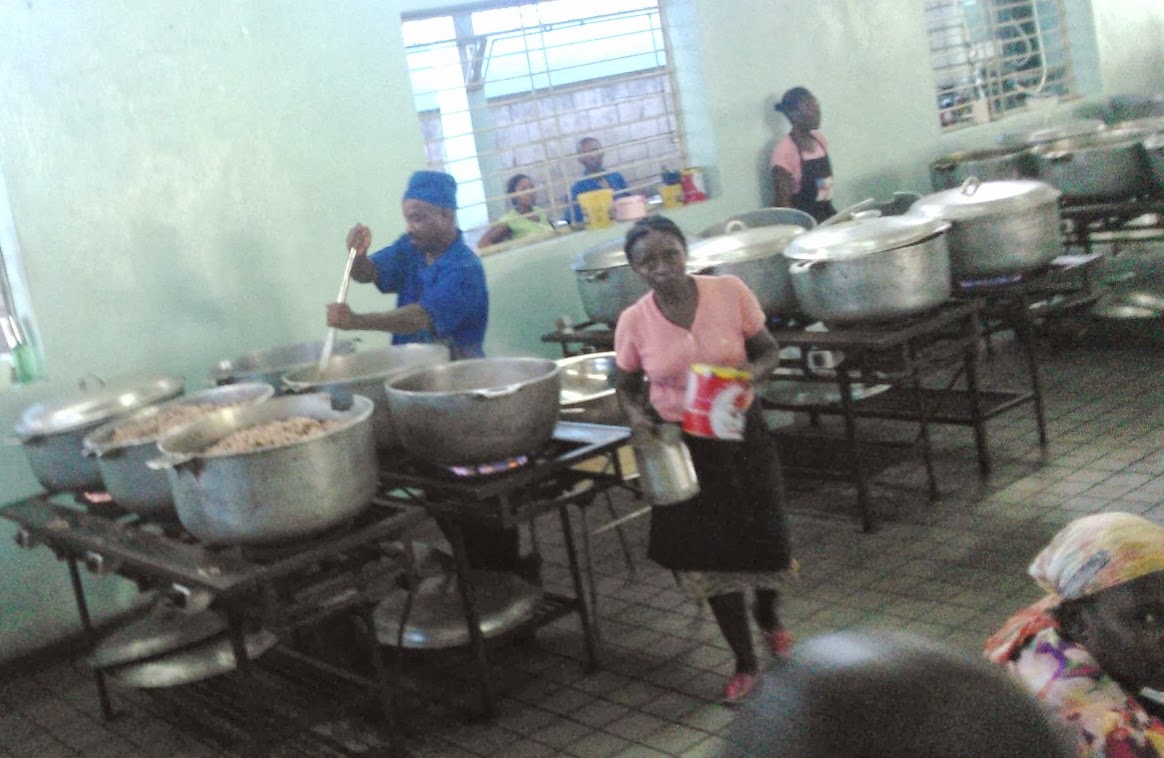
They also feed hundreds of people every day. They prepare one meal a day so that people without work and food can take it home to feed their family. Why did we visit a Catholic Charity? We don’t give them funds. They are doing a wonderful holistic work. They have asked WorldLead, the training effort of our home church to equip their top leadership in the Christian Leadership principles and will be gathering in November for that.


 S.T.E.P. Seminaire Theologique Evangelique de Port-au-Prince

Our next stop was Bolosse, on the hill above this city of eight million. From 9 am to 2 p.m. It was a privilege to come alongside this small group of mature servants of God. The main themes were:
·         “Spiritual Formation from Matthew’s Gospel,”
·         “Fruitful Practices for Finishing Well,”
·         “Mentoring,”
·         “Kingdom Communities.”

The men that we worked with all have a Masters or a Doctorate in Theology. So it wasn’t a question of giving them more knowledge, but wrestling with issues that stand in the way of healthy and fruitful leadership. These men desire to build more margin and improve their time with God but they are swamped. Two are pastors as well as seminary leaders. One man, Wawa, just became president of the seminary and had to take off to visit his wife in surgery. But he still made the effort to be with us whenever he could. Two missionary leaders are among the most godly and hardworking that I have ever known. You have to be a servant in Haiti; or else you won’t make it for long. The needs are just too overwhelming.

 
Fontamara Church Planting Team


I had hoped to meet with a group of 25 men and women, mostly lay evangelists and disciple-makers, that we trained in June. Tuesday, upon arrival, I found out that I was the designated teacher at the daughter church. It was started in August through intensive evangelistic efforts that touched 300 people. A group was baptized and they started services in September. I wasn’t prepared to teach that night and was tired from the long day. Assistant Pastor Giraud asked me to challenge them to be thinking already about starting a “grand-daughter church.” I see they learned the lesson about multiplication well. God gave me strength and passion to talk about being a branch that bears fruit from John 15. Some branches need to be cut back, others pruned, but all are called to bear much fruit to God’s glory. There is nothing that brings greater joy then being firmly connected to the life-giving sap and allowing it to produce fruit. “We can do nothing of eternal good in and of ourselves.” Mostly I wanted to bless them and encourage them as they grow this new kingdom community.

Giraud took me to see the new sanctuary being it built on the 3rd floor of Pastor Moise Vaval’s home. Already they are saying it is a temporary solution and they are praying for a lot in a more public neighborhood. The room could seat 200 and they had 85 for their inaugural Sunday. About 30 disciples and seekers of all ages came out Tuesday night. Four cell groups are meeting for prayer and Bible study. What a wonderful start! That was very rewarding.

Source de Grace Church

I was asked to speak on Christ's victory over Satan from Genesis to Revelation in the mother church on Wednesday. I almost expected some opposition or interference. It happened 2/3 of the way through the message. The wind and rain pounded the tin roof so hard that I could hardly hear myself, in spite of the amplification system. I waited and prayed. It got better and I started up preaching again, talking about how Jesus rebukes the wind and storm in the gospel of Mark and had authority over all storms.

Then the lights all went out and I lost sound. I was shut down in darkness with 200 people waiting. Giraud came up and said we can end now. I said "No wait, we can't end like this." God will see us through. Then the lights came back on and we finished the service. It ended with praise and confidence with a challenge to reap the victory that Christ won by going out boldly with the gospel. The rain continued. The van couldn't make it up the hill so I had to walk the last mile in the rain without an umbrella. I was drenched but grateful. God answers prayer and sees us through. Ps 34 says: "Problems often come to the righteous but God always delivers them." 


On Thursday I met with the church planting team. They are off to such a good start. But church planting is a marathon, not a sprint. They shared victories and challenges. They decided to meet regularly for prayer and planning. The Fontamara church plant has been functioning as a satellite of Source de Grace. But now the leaders must step up and train local disciples and leaders. It was obvious that they needed coaching to apply the church planting principles we learned together in June. They will go over their training little by little when they meet together and I plan to meet with them again in December. Ultimately the goal is to have a Haitian trainer and coach who can follow-up on site.


On Friday I returned home. The batteries were all charged in the plane. I was in Haiti for only 3 ½ days but what a fruitful time! Being a missionary is an adventure of faith, sometimes exhausting, sometimes exciting, and always stretching. I thank God for the prayers of each one and the contributions that allow me to go. Adventure or spiritual battle? Both. Definitely.

Monday, October 7, 2013

On March 11, 2011, on the North Coast of Japan a tsunami struck. What is happening two years later?


 Sendai is the closest airport. That's where we flew in. This map shows where the tsunami hit and the nuclear reactors were damaged.
 The coast line is beautiful. Surfers wait for the perfect wave. But on that day, March 11, 2011, they had no warning.
 
People went to the Shinto shrine that morning to offer an offering to their ancestors and wish for happiness.


 But on March 11, 2011, a 9.0 undersea quake sent waves barreling over this region. About 18,000 died, and 340,000 people displaced.  Missionaries and Japanese believers responded. The building you see was lifted and carried here. It has been left as a reminder of the disaster.
 The waves destroyed everything on their path. Even worse, the back flow took people out into the ocean, never to be seen again.
This is the first floor of a hospital on a hill. Linda is standing by the tsunami water line. The only people who survived on the first floor were those who ran up the stairwell. People outside in the parking lot watching the wave were washed away with the cars.
 

Where was God? This statue of Buddha survived but couldn't do a thing to help the people. But God heard the cries.

 People came from all over Japan and all over the world. They were mostly Christians. A team that was working further south moved in to area to share Christ's love in tangible ways. They worked together displaying the unity of the Body of Christ.

 
Many people do not want to move back to the region because of the painful memories, and in fact, don’t want to live near water. So as an incentive, the government will pay salaries to Japanese people who want to start businesses. The women on our team are working with Japanese on a project to collect shards of broken porcelain and make them into beautiful custom jewelry. It’s called the Nozomi (Hope) Project. Isn’t this a beautiful picture of what God is doing in the lives of people? Yuko became a Christian and was baptized after learning about Jesus. Her mother and pregnant sister got swept away in the tsunami, and her husband left her with 3 small children. She will be part of the jewelry making business which will provide her with some income.

We went to help the multicultural team we went to help ( members from U.S., Germany and Japan)  have been doing relief transition the starting a new church with those who are interested.
 
The multicultural team we went to help ( members from U.S., Germany and Japan)  have been doing relief and sharing God’s love with tsunami survivors through this Friendship Center. Japanese volunteers help out (pictured above). Rather than give handouts, they give Bingo prizes. Everyone receives a prize, even children.
 

Even the little girl got a prize!
 
 This building is a cooperative project between Samaritan's purse and other mission groups including ours.
 We found people quiet in public places, even the airport. But at the Friendship Center, they were loud, like Americans!... well almost.
 
 The team invited us to go on a strategic retreat with them for several days to discuss, “Where do we go from here to start this house church?” We met all day from 9-5, stopping only for lunch. We talked about strategy, evangelism, discipleship, and best practices for church planting. We looked at their spiritual gifts, some weak areas, and what they still needed to make their team complete, like additional Japanese workers. We will continue to coach them as they move ahead.
 
 We joined the team for worship in a house church. It is bilingual Japanese and English. Four churches have been started in Ishinomaki. But there are none up the coast in Oganawa. Not yet!


 We lived together in a house and prepared food. We shared our lives and their dreams, not just ideas.
Our friends want to start a house church in a nearby fishing town called Onagawa that has no church. They have been offered two plots of land: One, the city gave them to start a Welcome Center; another was offered by a businessman to start a second “Nozomi project” work place.


After dinner, we asked the team “What are your dreams?” As Linda listened to them, she had tears streaming down her face. They are men and women of faith. They all think that this time in history, can change Japan. Andy, the team leader, said, “The big waves of the tsunami, will bring about a new wave for the Gospel penetration.”
 
 
These American Japanese came to help out. They show with their lives and service "Our God has not forgotten you." Let us tell you about him. People don't forget the people of N. Japan.